

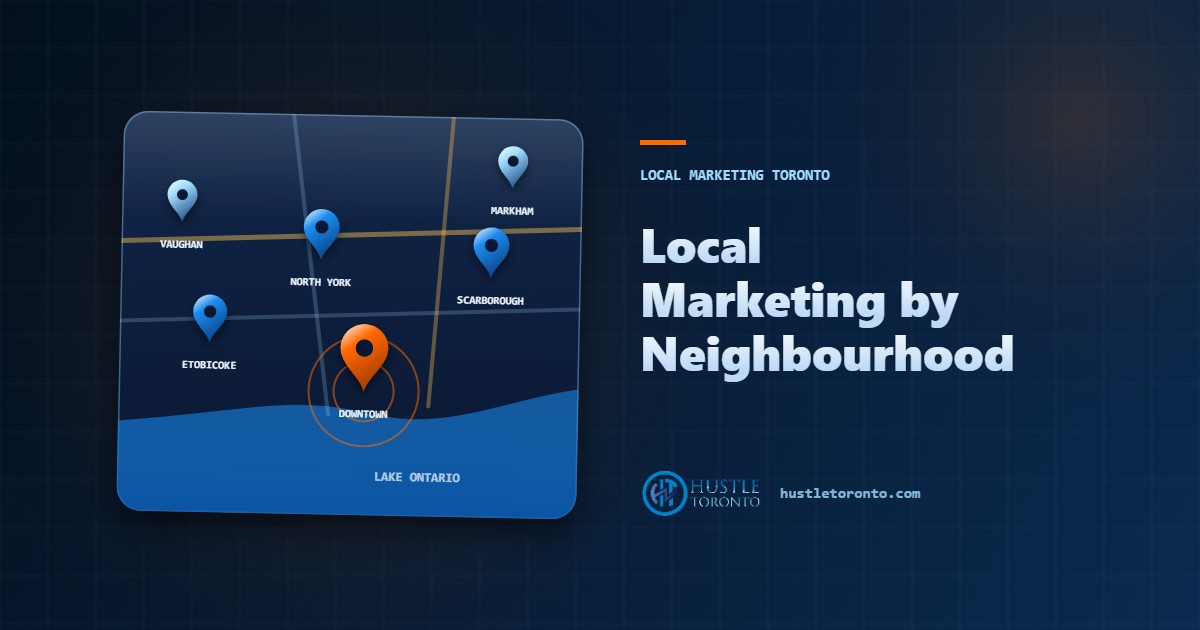
What is local marketing in Toronto? Local marketing means promoting your business to people in the specific neighbourhoods and cities you serve, through your Google Business Profile, local search rankings, location-targeted ads, community partnerships and neighbourhood-level content. In a city as large as Toronto, the most effective approach is to market street by street and neighbourhood by neighbourhood rather than to “Toronto” as a whole.
Toronto and the GTA are made up of very different communities, each with its own search habits, competitors and buying patterns. This guide shows how to plan local marketing at neighbourhood level, which channels to use and how to measure what works.
Why should Toronto businesses market by neighbourhood?
- People search close to home: searches like “dentist near me” or “plumber North York” return results based on location.
- Competition varies: ranking downtown can be far harder than ranking in Scarborough or Etobicoke.
- Messages land better: mentioning a neighbourhood, landmark or local event feels relevant.
- Budgets go further: ads targeted to a few postal codes waste less money than city-wide campaigns.
What are the main local marketing channels?
| Channel | What it does | Effort |
|---|---|---|
| Google Business Profile | Appears in map results and local searches | Low to set up, ongoing updates |
| Local SEO | Ranks your website for location-based searches | Medium, builds over months |
| Location pages | Dedicated pages for each area you serve | Medium |
| Local paid ads | Google and Meta ads targeted by radius or postal code | Medium, immediate results |
| Reviews | Builds trust and improves map rankings | Low, needs a routine |
| Community partnerships | Sponsorships, events, local business associations | Varies |
| Local social content | Posts and Reels about your area and customers | Medium |
How do you set up your Google Business Profile for local reach?
- Choose the most accurate primary category and relevant secondary categories.
- Set your service areas if you travel to customers, listing the neighbourhoods and cities you cover.
- Add accurate hours, phone number, website and services with descriptions.
- Upload real photos of your team, premises and work.
- Post updates, offers and events regularly.
- Ask every happy customer for a review and reply to all reviews.
Google explains how local results are ranked, based on relevance, distance and prominence, in its help article on improving your local ranking.
How do location pages help local marketing?
A location page tells Google and visitors that you serve a specific area. A good one is genuinely useful, not a copy of other pages with the city name swapped. Include:
- The services you provide in that area and how you deliver them.
- Local details, such as neighbourhoods covered, travel times or parking.
- Examples of work in that area, where you have them.
- Reviews from local customers.
- Clear contact options and a map.
For example, we have pages for North York, Scarborough, Etobicoke, Mississauga, Markham and Vaughan.
How do you run neighbourhood-level ads?
Google Ads
Target by radius around your location or by specific postal codes and neighbourhoods. Use location words in ads and send clicks to the matching location page.
Meta ads
Target people living in or recently in an area. Short videos featuring recognizable local places tend to perform well.
Tips for both
- Exclude areas you do not serve, to avoid wasted clicks.
- Schedule ads for the hours you can answer the phone.
- Compare cost per lead by area and move budget to the best ones.
What offline local marketing still works in Toronto?
- Joining a local Business Improvement Area (BIA) or chamber of commerce.
- Sponsoring community events, schools or sports teams.
- Partnering with complementary local businesses for referrals.
- Door hangers or flyers in targeted areas, with a trackable code or URL.
- Vehicle and storefront signage with your website and phone number.
Offline activity also creates online signals: local mentions, links and searches for your name.
How do you create local content people actually care about?
- Guides tied to your service and area, such as costs, permits or seasonal advice for Toronto.
- Customer stories from specific neighbourhoods, with permission.
- Behind-the-scenes posts at local jobs or events.
- Answers to questions local customers ask often.
How do you measure local marketing results?
- Calls, direction requests and website clicks from your Google Business Profile.
- Rankings for “service + area” keywords in Search Console.
- Leads by location, using form fields or call tracking.
- Review count and average rating over time.
- Cost per lead by neighbourhood for paid campaigns.
How can Hustle Toronto help with local marketing?
We help GTA businesses with local SEO, Google Business Profile management, location pages and targeted ads. Learn more about our local SEO services, read what local SEO services include, or see our guide to finding a marketing agency near you.
Frequently asked questions
What is local marketing?
Local marketing promotes a business to people in the specific areas it serves, using Google Business Profile, local SEO, location-targeted ads, reviews and community activity.
How do I get my business to show up in Toronto map results?
Complete and verify your Google Business Profile, choose accurate categories, add photos and services, earn reviews regularly and keep your details consistent everywhere.
Should I create a page for every neighbourhood?
Only for areas you genuinely serve, and only if each page offers useful, specific information rather than repeated text with a different place name.
Do flyers still work for local marketing?
They can for home services and local shops when targeted to the right areas and tracked with a unique code, phone number or web address.
How long does local SEO take in Toronto?
Google Business Profile improvements can show results within weeks; local organic rankings usually take three to six months, depending on competition.
Talk to a Toronto marketing team
Want more customers from the neighbourhoods you serve? Book a free 30-minute strategy call, call +1 437 333 3496, or send us a message.